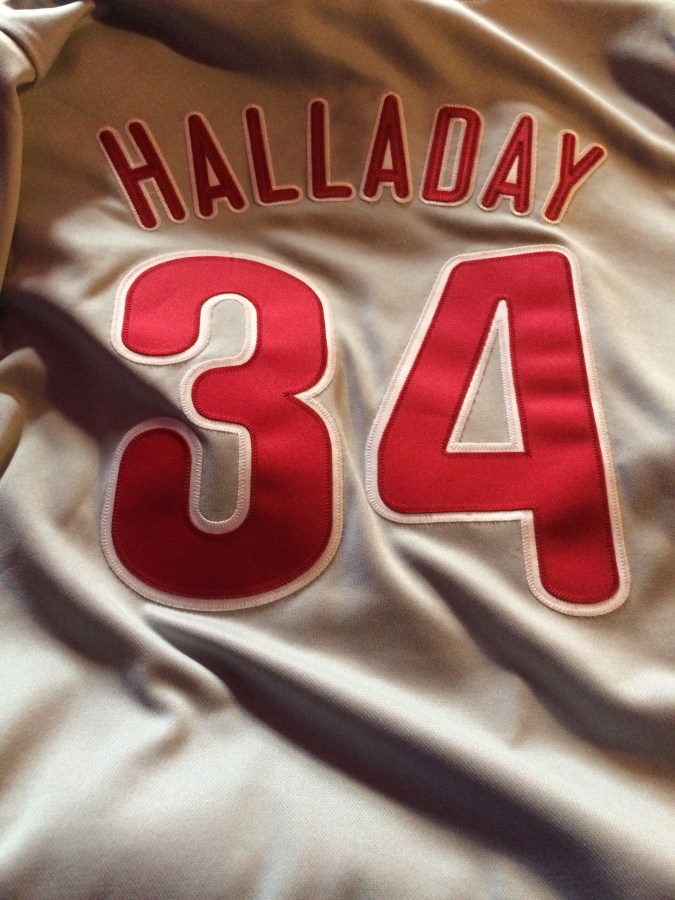
I had a ticket to Roy Halladay’s no-hitter in the playoffs against the Reds in 2010. A stomach virus flattened me that morning, however, and I had to give the ticket away. I watched baseball history from the discomfort of my family room, a bucket next to me. But I didn’t miss a pitch.
I’ve seen the final out of that game several times in the last 18 hours: Chooch racing from behind the plate to field a swinging bunt that had trouble written all over it; the perfect throw to first from his knees; the wild celebration; the fans, minus me, going beserk.
This morning I was on the road and listened to sports radio for awhile. Today there were no made-up controversies, no shouting matches, no inane observations, no disagreements. It was people, hosts and callers, saying nice things about a man who was apparently an even better human being than he was superstar pitcher. Most of the rest of the country probably said, “That’s a shame” about his death and moved on. In the Philly region, an unofficial period of mourning has been tacitly declared.
One of the observations made by Anthony Gargano on The Fanatic was the specialness of sports in the Philadelphia area. Devotion to teams is passed through generations. Those we annoint as worthy of our devotion become members of the family. We refer to them by first names or nicknames as if they had just left the house. “Did you see Chase’s hit last night?”; “What a play by Chooch!” We especially like people who work hard; hustle; don’t make excuses; leave it all on the field, ice, or court. And they are the kind of people we could imagine ourselves talking to at a barbecue.
Today, a caller from Tampa related how he was on leave from Afghanistan when his father invited him to watch that night’s Phillies’ game on TV, just so they could have some father-son time. Together they watched Roy throw his perfect game in Miami. The caller felt that, because of his military service and maturity, his father treated him like a man for the first time, not just a son. And that moment in time is intertwined with baseball because of Roy Halladay’s perfection.
In 1964, Jim Bunning pitched a perfect game against the New York Mets on Father’s Day. I was watching the game with my dad. If there was any Phillies pitcher who could approximate Roy Halladay, it was Jim Bunning. Intense. A winner. Successful in both leagues. A gracious human being. I was so nervous on that June day that I had to watch the last couple of innings from the porch. My agonizing was annoying–and pleasing–my father. We rejoiced at the final out. Here it is 53 years later and the reverie is still poignant and pleasant.
There are a lot of things wrong with professional sports, but they have the potential to create memories, bring us together, and show us what we can achieve.
Roy Halladay was not always perfect on the mound or in life, I suppose.
But he tried to be.

 The Q-View
To me, what’s being said about Halladay is the best legacy one can have: to be an “even better human being than” whatever job title they held. In the end, I think that’s all that matters.
LikeLike