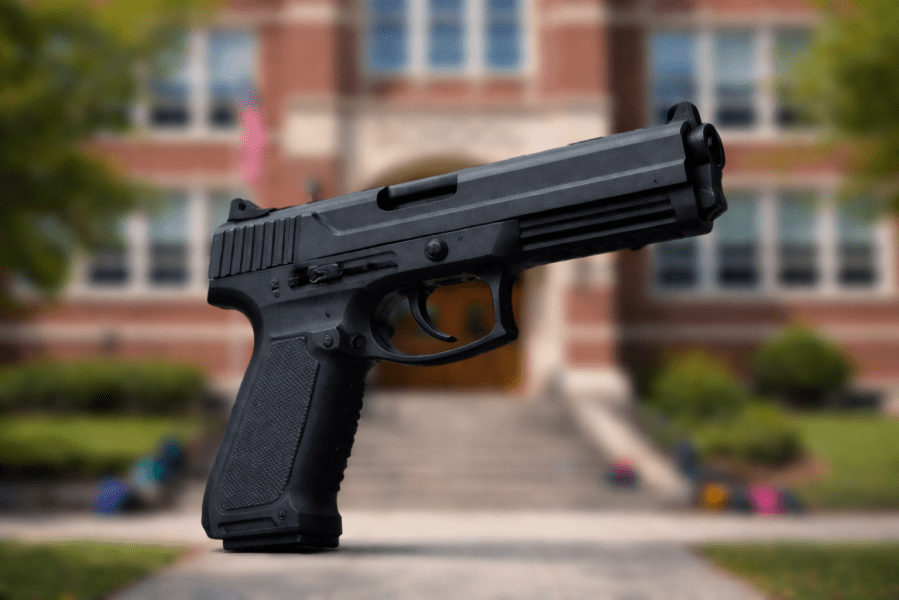
My compilation of writings, Whatever the Art of Moving On, is in the process of being edited. In a previous blog, I shared that the first story, “Black and White,” is a fictional version of a school shooting in progress, and I shared some excerpts from a memoir about reactions to the Sandy Hook shooting several years ago.
I can tell you firsthand what it is like to be in a building where a shooter is loose. Memories of that day remain vivid thirty-three years later.
There is a caveat, however. The situation had been resolved by the time I became aware that there was a shooter in the building and that a student had been shot through the head in a biology lab on the floor above where I was situated.
These were the days before school shootings were a “thing,” even though they had been occurring across the country. Public awareness changed after the Columbine shootings–and the wall-to-wall TV coverage that it received.
I was in the cafeteria during first period that May day, covering a study hall of about 50 students. At about nine o’clock, one of the guidance counselors rushed in to tell us to stay put until further notice. Which we did.
No hiding; no locked doors; no plan whatsoever.
Although there were 124 school shooting incidents in the 1960s; 55 in the 70s; 80 in the 80s; and 49 before the shooting at our school in 1993, leading to six fatalities and three injuries, the educational world was, apparently, willfully blind to reality. Why prepare for something that always happens elsewhere?
My school certainly had not prepared.
There we sat. Cafeteria doors at both ends wide open.
At one point, the same guidance counselor came back to the caf and went over to a female student and said something to her. The girl burst into tears and left with the counselor.
Turns out the girl was the sister of the shooter.
I learned about the shooting a little later when I stepped out into the hall and asked another teacher what was going on.
We sat until buses came to pick up the students. No one was allowed to go to their lockers. Those who had driven to school had to find another way home. The classrooms were frozen tableaus of a typical school day: books open on top of desks; incomplete tests; blackboard notes; sweaters on the backs of chairs.
Except in the bio lab, which was a crime scene. A junior boy had shot his alleged tormentor to death.
I went to the chaotic office to remind the principal to make sure our home playoff baseball game was postponed, and to try to find a phone to call my wife.
After a time of milling around and sifting through rumors, the teachers were sent home, driving past news vans parked at the school exits.
Police did their investigating, and the janitors cleaned brain matter and skull and blood off the floor and ceiling of the bio lab.
Details were slowly filled in: the shooter had fled the building immediately after the murder and was found sitting under a tree at the edge of the school property; not knowing that, a vice-principal had searched the building, an unarmed vice-principal; the motive was revenge for bullying; the biology teacher was beyond devastated; the other kids in the class traumatized.
A report subsequently published in a local newspaper gave more insights into the shooter’s plans, including shooting up the cafeteria–where I was watching the study hall.
Surprisingly, we had school the next day. All of my classes wanted to discuss what happened, so we talked about it in the beautiful May sunshine while we sat on some grass. I wanted to get them out of the building. Forget trying to teach.
And we played our baseball playoff game at home.
In the locker room before the game, I asked a team meeting if there were any problems. One of our JV players had been in the lab when the shooting happened. He was not there.
I urged them to use the next couple of hours to forget about what happened and to be “normal.”
We won the game–imagine being on the other team and driving an hour to the site of a school shooting the day before–and the players got to focus on something positive.
And the school year ended a couple of weeks later.
After Columbine, in April 1999, plans were made, shooter drills were done, and “lockdowns” became part of the culture of school life.
Since 2000, there have been 642 school shootings resulting in 498 deaths and 953 wounded.


 The Q-View