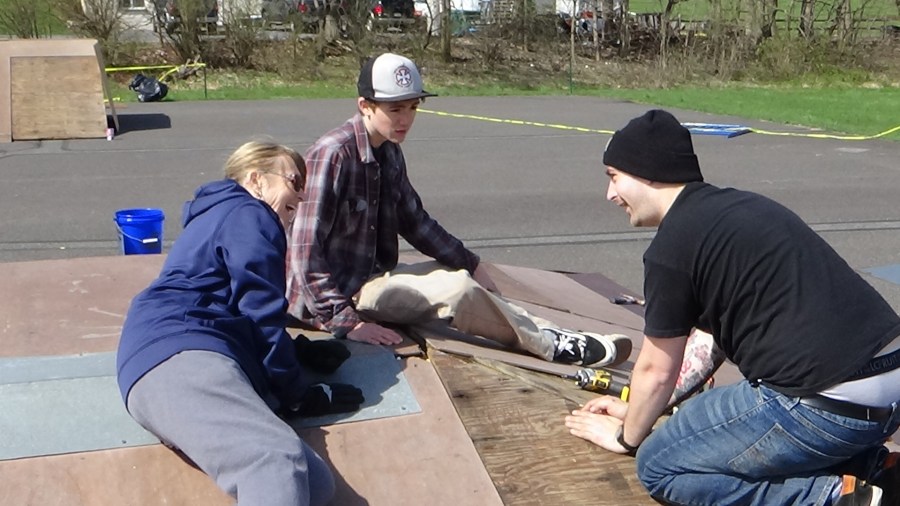
I certainly received an education yesterday. I learned a few things about the world of skaters and their views of how they are perceived.
The local anti-drug task force I belong to held a day to clean up the local skate park which had fallen into disrepair. The idea was to build connections with a disaffected group stereotypically associated with drug use.
Comcast footed much of the bill and supplied some volunteers as part of its Comcast Cares Day. It was nice to see at least a little bit of a soul, as Tom Joad said in The Grapes of Wrath, from a mega-corporation. They are, after all, people as the Supreme Court told us a few years ago.
Anyway, what was most interesting to me was the fact that many of the adult craftsmen on hand were ex-skaters.
A local carpenter, now 40, told me, “I rode skateboard and biked when I was a kid; we didn’t really have anywhere to go. The fact that there’s somewhere that can be fixed up to go is good. I’m just here to help.”
Another volunteer ex-skater was there to “basically, show [teen skaters] that other people care. The whole skateboarding thing’s like a subculture. When I was one in my early teens, you feel, like, ostracized. I want to show that they’re not; they’re just as much part of society as all of us.”
A third volunteer who was there with his teenage daughter said, “It’s probably a bad choice of mine, but I broke out my old skateboard, and I have it in the car to try things out after we’re done reworking everything.”
First of all, as someone who is tool-challenged, it is fascinating to me to watch professionals-who-work-with-their-hands do their things. Art in motion; poetry out of a tool box; practical music.
Secondly, as some of them implied, less “academic” people in general, and skaters specifically, were and are looked down upon, and most seem to have to move in their clique to survive some of the social cruelties inflicted because of lazy, and too comforting, stereotyping.
There were several teenagers helping out, the kids who will actually use the park. It was nice that they were consulted on the placement of various ramps and the configuration of the park in general. I learned that the way the ramps had been set up blunted the momentum gained coming down some of the slopes. The adults made the modifications the kids wanted.
The teen skaters are not naive to how they are viewed. One had the courage to respond to Facebook disparagement about the project.
“It’s important because skaters and BMX’ers and scooters need somewhere to go to ride with their friends and just hang out,” he said. “We’re really not bad people. We’re just trying to have fun. It’s like a lifestyle to us.”
One of the teens who was there is a supremely talented cook headed to a culinary school after high school graduation. He had to leave the clean-up to go to work at a local restaurant.
But, you know, he’s a skater.
So were a lot of the volunteers who are now obviously successful professionals.
No doubt some of these kids can be their own worst enemies. At the clean-up there was poorly secreted vaping going on. Some with juuls. F-bombs were sprinkled into their conversations. Adult directions were sometimes countered with snide comments.
The last thing some people around the park wanted was a renovated area that will attract more teens.
Another of the teens struck a hopeful chord because they now feel some ownership for for the park. “Anyone who actually cares about it, they’re not going to come here and trash the park.”
For the neighbors’ sake and the skaters’ sake, hopefully he is correct.
Peer pressure can work both ways.


 The Q-View